When a Family Office Needs a CFO – and When It Doesn't

Julia Pelikhanova, Founder & CEO
Most family offices do not begin with a finance function. They begin with a person the founder trusts – a long-standing accountant, a banker who became a friend, a finance director borrowed from the operating business – and a growing pile of entities, accounts and advisers around that person. At some point the pile becomes visible. A bank asks for consolidated figures nobody can produce in under a month. The tax adviser and the lawyer give answers that do not agree. The next generation asks a simple question about returns, and the answer takes three weeks. The founder concludes, reasonably, that the office needs a CFO.
Sometimes it does. Often it needs something narrower, or something different, and the title is the most expensive way to find that out.
Start with the work, not the title
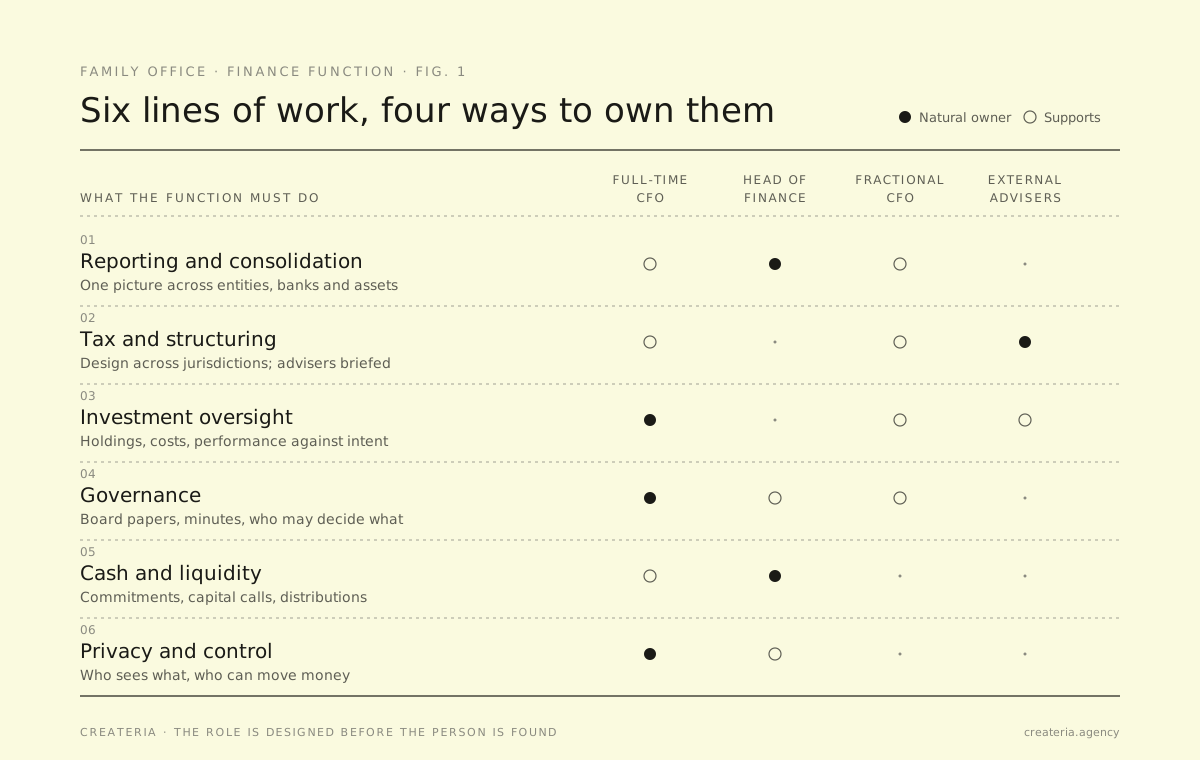
"CFO" in a family office can mean almost anything: a senior accountant with a better business card, a former banker running the portfolio, a chief of staff who happens to read a balance sheet. Before anyone is approached, set the title aside and list what the finance function actually has to do. In most offices the list has six lines.
Reporting and consolidation. One accurate picture of what the family owns, across holding companies, trusts, operating businesses, property and accounts held with several banks. Produced on a schedule, on a basis the family can rely on.
Tax and structuring. How the structure is built, how it changes when a family member moves country or a business is sold and how the advisers who design it are briefed and held to account.
Investment oversight. Not choosing investments, but knowing what the portfolio holds, what it costs and how it performs against what was intended – and whether the private bank's figures match the custodian's.
Governance. Preparing the family board or investment committee, recording what was agreed and making sure that each matter is settled by the people entitled to settle it.
Cash and liquidity. What is available, what is already committed – capital calls, tax payments, family distributions – and what would have to be sold, at what cost, if something unexpected arrived.
Privacy and control. Who sees what, who can move money, how payments are approved and how much of the family's financial life is visible to staff, advisers and banks.
Very few people are equally strong on all six. The controller who builds clean consolidation is rarely the person who can hold their own with tax counsel in another jurisdiction, and neither is necessarily the person to challenge a private bank on fees. The useful question is narrower than "do we need a CFO?" It is which of these lines needs someone senior, inside the office, every week.
Signals that the office needs a full-time CFO
A full-time CFO earns the seat when several lines are heavy at once and the judgement they require cannot be bought by the hour. The signals look like this.
The structure spans several jurisdictions, and a change in one regularly creates consequences in another. The advisers are numerous and each sees only their own piece; somebody has to hold the whole and tell them where their advice collides. The office holds direct investments or operating businesses, not only liquid portfolios managed by banks, and those holdings need financial scrutiny from the owner's side of the table. Family members have different interests – some drawing income, some reinvesting, some not yet involved – and the reporting has to serve all of them without favouring any. And the founder is still the only person who sees the full picture, which means the office's continuity rests on one memory.
When three or more of these hold, a controller with a larger title will struggle, and an outsourced arrangement will produce reports without producing judgement.
Signals that it does not need one yet
The opposite case is just as common and less often admitted. The assets are largely liquid and held with one or two banks that already consolidate the reporting. The structure is stable and sits in one country. Investment choices are made by the founder with an external adviser, and nobody intends to change that. What is missing is reliable bookkeeping, timely consolidation and someone to chase the paperwork.
That is a head of finance or a controller, supported by a fractional CFO for the quarterly review and by the existing tax and legal advisers for structuring. It costs less, and it is honest about the size of the role. A senior CFO hired into an office with this much work tends to do one of two things: leave within a year, or begin building complexity the family never asked for, in order to justify the seat.
There is a third case worth naming. If the real question is how the capital should be invested – allocation, managers, direct deals – the office may need a chief investment officer rather than a CFO. The two roles overlap at the edges, and many offices combine them in one person by default. That can work in a small office. It works less well when the person who chooses the investments is also the person who reports on how they performed.
What to design before anyone is approached
Whichever answer the office reaches, four things should be written down before a search begins. They are close to the agreements we set out for a COO search, shaped by the particular conditions of a family office, and they are where Composition begins: the role is drawn first, the person is found for it second.
The mandate. Which of the six lines the role owns, which it coordinates and which stay with advisers. And, just as precisely, what the founder keeps: signing authority above a threshold, the relationship with a particular bank, the final word on distributions.
Whom the role answers to. The founder, the family board or the head of the family investment fund. In many offices all three exist, and they will not always agree. A finance lead who receives one instruction from the founder and another from the next generation is in an impossible position, unless the office has settled in advance whose voice is final and on which matters.
Confidentiality. What the role will see, and what it will not. Some families want one person with full visibility; others deliberately divide knowledge between people. Either can work. What does not work is discovering the boundary after the hire, when the new CFO asks for a document and is told it is none of their concern.
The advisers already in place. The private bank, the tax counsel, the long-serving accountant. Each has a relationship with the founder that predates the new role and may outlast it. Is the CFO expected to manage them, to challenge them or simply to work alongside them? An adviser who has had the founder's ear for fifteen years will not hand it over because a title has changed.
Assessing for the role, not the CV
Once the role is designed, the assessment changes. A candidate with a strong corporate finance career may be excellent at closing the books and weak at the part that matters most here: earning the trust of an owner who has never delegated financial control and being able to say "I don't know yet, I will check" without losing standing. The evidence worth having is less about what the candidate has run and more about how they behave in conditions like these – one principal, unwritten standards, little formal process and confidentiality as a working condition rather than a clause in the contract.
That evidence can be collected. A finalist can be given a real, anonymised consolidation problem from the office and asked to walk the founder through it, and the conversation observed. References can be taken from owners the candidate has worked for, not only from colleagues. And the office itself can be read before the brief is written, which is the purpose of The Mirror: a look at the environment the role will enter, before anyone is asked to enter it.
The quieter conclusion
Many family offices that set out to hire a CFO end up with a head of finance and a fractional CFO, or with a CFO whose mandate is narrower than first imagined. That outcome is often the right one: a role that fits the office as it is, with room to grow when the office does.
The costly outcome is the other one: a senior person hired into a role nobody designed, reporting to two people who have not agreed, with access to half of what they need to see. They leave, and the office concludes it hired the wrong person. Usually it hired the right person into the wrong role.
Createria designs the role before searching for the person – for funds, founder-led companies and, increasingly, family investment offices, where the owner, the board and the family are not always separate. If a finance hire is on your agenda, start with a conversation about what the role must hold, and what it need not.