What to Agree With the Board Before You Start a COO Search

Gregory Golodnov, Chief Operations Officer & Operational Architect
A COO search rarely fails on the candidate. It fails at the offer stage, when the finalist asks what exactly they will own and three people in the room give three different answers. Or it fails in month four, when the new COO makes the first decision they believed was theirs and discovers it was not.
Both are the same failure. The search was started before the people who own the company had agreed on what they were hiring for. The candidate is simply the one who pays for it.
Why the COO role is different
A CFO owns finance. A CTO owns technology. A COO owns whatever the owner or the CEO has decided to stop holding – and that is not a job description. It is a negotiation, usually an unfinished one.
The COO is the role a company invents to give away what its leader can no longer carry alone. Which means the role is defined by subtraction: by what the founder, the CEO or the family will actually let go of. In a portfolio company, that may be the fund's operating partner. In a founder-led company, it is the founder. In a family investment fund, it is the owner and, often, the next generation with formal authority and unclear influence. In every case, the person defining the role is also the person who has to give something up to make it real.
That is why COO searches are the most mandate-sensitive searches there are. We noted in our piece on management due diligence that the gap between assumed and real authority is the most common reason a portfolio CEO leaves early in the hold. For a COO the gap is wider, because the authority in question never belonged to the role. It has to be carved out of someone else's.
The board test
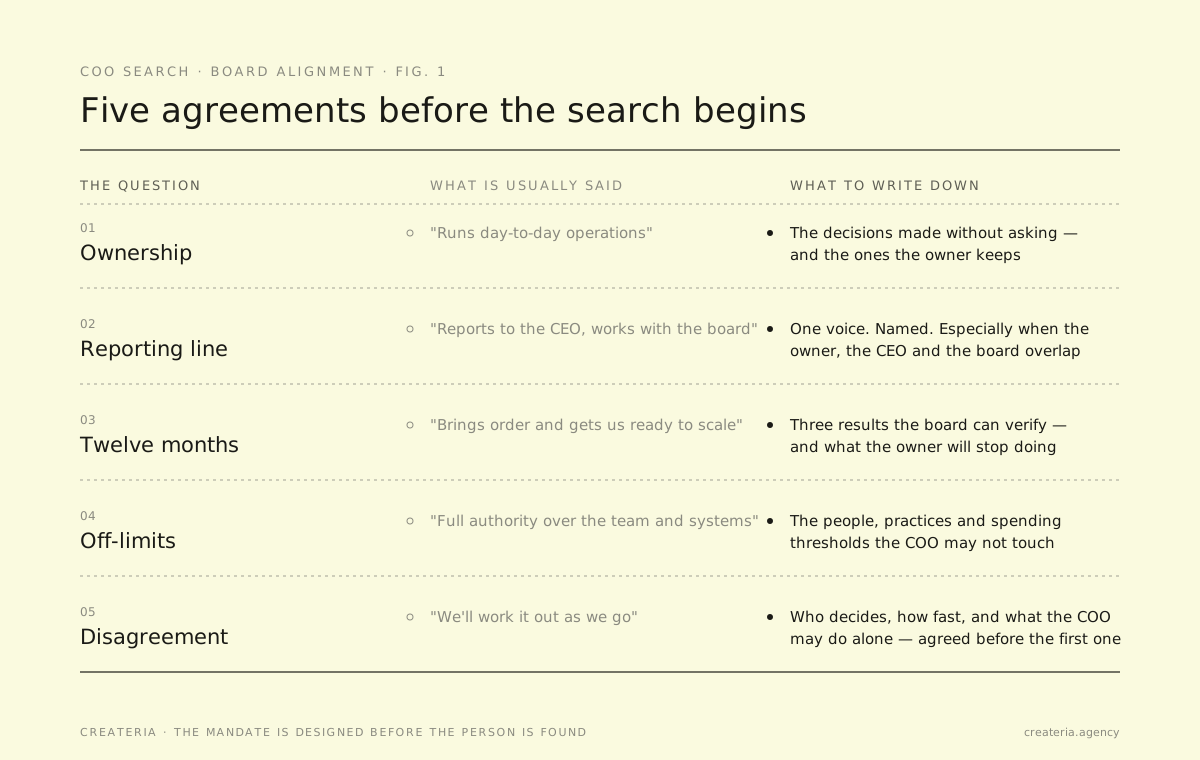
Before the brief is written, ask each person who will have a say – the owner, the CEO if they are not the same person, the board or family members who will sit in the final interview – to answer five questions in writing, separately, without discussing them first.
Then put the answers side by side.
The gaps between those answers are not a problem to solve later. They are the search brief. A candidate cannot be assessed for fit with a mandate that does not yet exist, and no candidate, however strong, can resolve a disagreement between owners by being hired into the middle of it.
The five agreements
1. What the COO owns outright. Not "runs day-to-day operations." Which decisions will the COO make without asking – hiring below a certain level, spending below a certain threshold, changing a process, stopping a project? And, just as precisely, which decisions the owner keeps. The second list is the harder one to write honestly, and it is the one candidates actually need. An owner who cannot name what they are keeping has not yet decided to let anything go.
2. Who the COO answers to – one voice. "Reports to the CEO, works closely with the board" is the standard line and the most common source of damage. When the owner is also the CEO, when a fund's operating partner is in the building every week, when a founder's parent sits on the board, the COO will receive instructions from more than one direction, and the instructions will not agree. Decide now whose voice is final on operational matters, and say it out loud to everyone who might otherwise assume it is theirs.
3. What twelve months of success looks like. "Brings order and gets us ready to scale" cannot be verified. Three results the board can check can be: a delivery metric, a cost line, a function that runs without the owner in the room. Add one more line that is rarely written: what the owner will personally stop doing by month twelve. If nothing is on that line, the COO is being hired as a very expensive chief of staff, and the search should say so.
4. What is off-limits. Every company has them: the long-serving head of sales who reports informally to the founder, the supplier who is also a friend, the reporting ritual nobody has questioned in ten years. "Full authority over the team" is what gets promised. What exists is a set of people, practices and spending thresholds the COO may not touch, at least not in the first year. Naming them is not weakness. It is the difference between a COO who navigates them and a COO who blunders into them in week three and loses the owner's trust before earning it.
5. What happens when the COO and the owner disagree. They will. A strong COO is hired precisely to see things the owner does not, and the first real disagreement is the moment the mandate either becomes real or evaporates. "We'll work it out" is not a rule. Who decides, how quickly, whether the COO can act first and inform later and what the COO may do alone even when the owner would have chosen otherwise – all of this is settled far more easily before a candidate has a name than after.
What changes in the search itself
Once the five agreements are written, three things happen.
The brief becomes honest. Instead of a wish list of experience, it describes the actual authority on offer and the actual constraints around it. Candidates who would have withdrawn at the offer stage withdraw at the first conversation, which costs the company weeks rather than months.
The assessment gains a target. A mandate that is written down can be tested for. A finalist can be asked to present a first-hundred-days plan to the actual board, and the board's reaction observed – not the candidate's polish, but whether the owner can sit through someone else's plan for their operations without taking it back. That observation is evidence about the pair – the executive and the environment together – and it is impossible to collect without a mandate to plan against.
The first hundred days get a script. The agreements become the onboarding plan: the decisions the COO makes in week one to establish the mandate, the off-limits areas they leave alone, the first disagreement handled by the rule rather than by improvisation.
The uncomfortable part
Every one of the five questions is really the same question asked five ways: what is the owner prepared to give up? That is why boards prefer to skip them and start interviewing. Interviewing feels like progress. Answering the questions feels like a loss.
But the loss is coming either way. The only choice is whether it is taken deliberately, on paper, before the search – or extracted in month four, from a COO who was promised authority nobody had agreed to give, in front of a team that is watching to see whether the new role is real.
We have written before about why C-level hiring breaks when decision-makers step aside. A COO search is the sharpest case: the decision-maker cannot step aside, because the decision being made is about their own authority. The board's job is not to find the COO. It is to agree on what the COO will be allowed to be. The finding is the easier half.
Createria designs the mandate before searching for the person – for founder-led companies, PE portfolio companies and family investment funds, where the owner, the board and the CEO are not always three different people. If a COO search is on your agenda, start with a conversation about what the board has agreed, and what it has not.