Potential Over Experience: Why Track Records Don't Predict Executive Success

Julia Pelikhanova, Founder & CEO
Almost every executive brief we receive opens the same way. Ten or fifteen years in the function. Has done this twice before, ideally at a company like ours. A track record the board can point to.
It is a reasonable instinct, and experience is one of the weakest predictors available. Decades of research on what actually forecasts performance put years of experience near the bottom of the table, below almost every method a company could use instead. The instinct persists because a track record is easy to see and potential is not. But a search built on the wrong predictor produces the right-looking candidate and the wrong outcome, and the outcome is what the board will live with.
What the evidence says
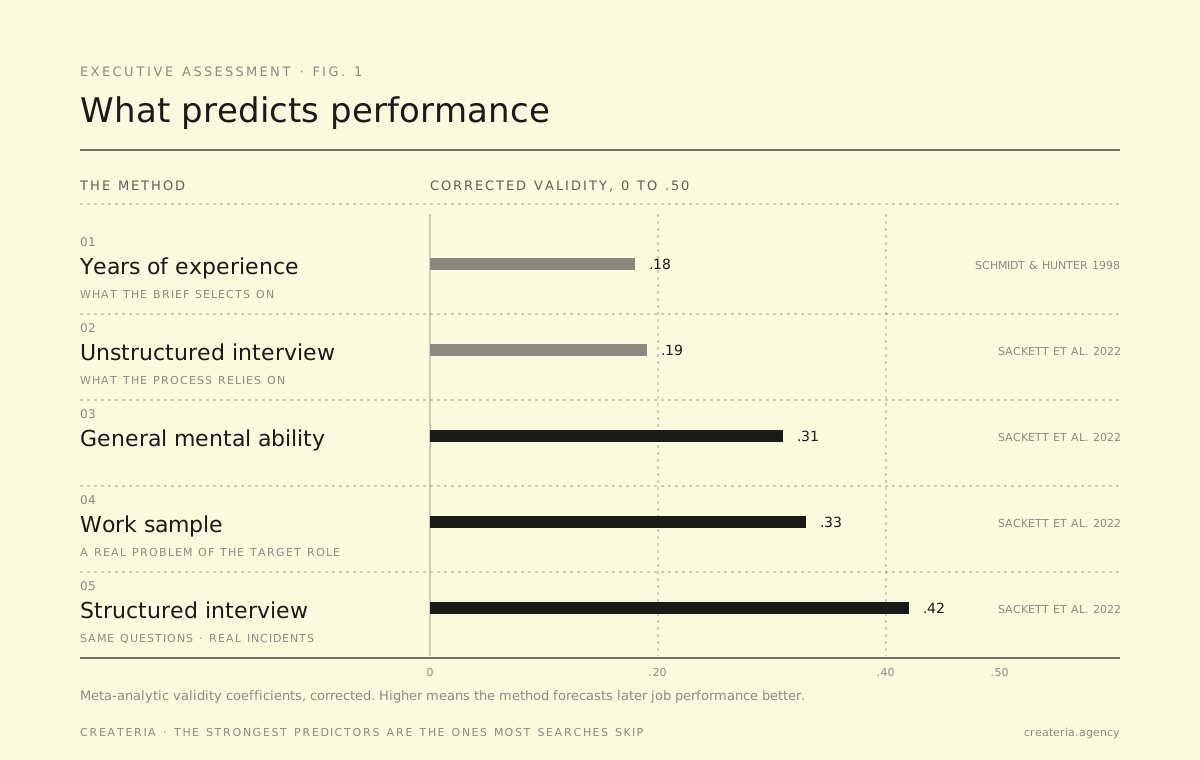
The landmark meta-analysis of hiring methods, Schmidt and Hunter's review of eighty-five years of research, put the predictive validity of years of job experience at .18. On the same scale, structured interviews and work samples scored roughly three times higher. A 2022 revision of those estimates by Sackett and colleagues corrected most figures downwards without changing the broad picture: structured interviews at .42, work samples at .33, general mental ability at .31, the unstructured interview at .19.
Read together, the two studies describe the typical executive search with uncomfortable precision. The brief selects on experience, the weakest signal in the chart. The process then relies on unstructured conversations, barely stronger. The strongest tools, a structured interview and a piece of real work, are the ones most searches never use.
One nuance matters. The research distinguishes between how long someone did something and what they actually did. Measured by tasks performed and problems solved, experience predicts better than when measured in years. Which is the first clue about what the track record is really telling you.
Why a track record misleads
It is the history of a pair, not a person. A CEO who doubled revenue did it inside a specific company, with a specific board, a specific team, a specific market window. The result belongs to that combination. Move the person and you have kept one half of the equation and thrown away the other. We wrote about this in the context of management due diligence for private equity: the track record proves that potential was realised once, in one environment. It does not tell you whether it will be realised in yours.
It rewards being present, not being the cause. Titles from companies that grew are abundant. Evidence of who made them grow is rare. A search that filters on the former will fill the shortlist with people who stood near success, and only a different kind of questioning separates them from the people who produced it.
The next role is always a first. This is the part boards find hardest to accept. At C-level, every meaningful step is something the person has not done before: the first time running a function they did not build, the first board that is a family, the first company that is running out of money. You are not hiring for what the candidate has done. You are hiring for what they have not done yet, and a track record, by definition, contains no evidence about that.
Add the speed at which companies change and the case closes. Claudio Fernández-Aráoz argued in Harvard Business Review that the competencies a role will require can no longer be predicted even a few years out, which makes potential, not past competence, the deciding factor. That was in 2014. The argument has aged well.
What potential actually is
Potential is not a label for promising juniors, and it is not raw intelligence. It is the capacity to grow into a role that does not yet exist for the person, and it has observable markers. Fernández-Aráoz names five: the right motivation, curiosity, insight, engagement and determination. In our own assessments, three of them do most of the work.
Learning speed. How quickly the person turns experience into changed behaviour. The clearest evidence is the story of a failure told without defence, followed by what they did differently the next time, and how soon.
Firsts. How many times in the career the person did something without a playbook, and what happened. A CV with three identical roles at rising scale is a record of repetition. A CV with three different problems solved is a record of range.
Motivation that the role can feed. What actually drives the person – mastery, influence, commerce, security or legacy – and whether this role supplies it. Potential that the environment starves does not get realised, however real it was.
How to assess it before the hire
The methods that predict best are the ones that make the candidate show rather than tell, and they are available to any company willing to run them.
Structured interviews built on incidents. Every candidate answers the same questions about specific situations they were in: the decision, the constraint, what they did, what it cost. Not what they believe about leadership. What they did on a Tuesday when the plan broke.
A work sample from the target role. Take a live problem from the company itself, not one from the candidate's last company, and ask for a plan, presented to the people who will actually judge it. It tests the role that is being hired for, which the track record cannot. It also tests the board, which is often where the real finding is.
Psychometrics for drivers and derailers. Not the personality quiz. Instruments that measure what motivates the person and how they behave under sustained pressure, because the same pressure that surfaces potential surfaces its opposite.
References that ask one question. Chosen by the assessor, including former boards and investors. The question is not whether the person was good. It is: what did they do here that they had never done before, and how quickly did they get good at it?
And the other half of the pair. Potential is realised in an environment, so the environment has to be assessed with the same seriousness as the candidate: what the board really expects, what it will really delegate, what the team supplies and lacks. Half of the executive failures we see are failures of a system that was never examined. The person had the potential. The environment had no room for it.
Potential over experience is not potential instead of experience
There are roles where a specific body of experience is non-negotiable: a regulated industry, a technical domain with a decade of tacit knowledge, a turnaround with no time for anyone to learn. Say so in the brief, and then assess for potential within that constraint rather than treating the constraint as the whole assessment.
Everywhere else, the honest arithmetic is this. Experience is a bet with more variance than it looks, because so much of what it records belonged to a different environment. Potential is a bet with less variance than it looks, because it can be measured, and measured with the tools that predict best. The board that insists on ten years and two prior stints has not reduced its risk. It has chosen the risk it can see over the one it can measure.
We have written about how this plays out in markets where the experienced pool is thin, where the choice is not philosophical but forced. The lesson from those searches generalises: when the track record is not available, companies assess potential properly, and the hires hold. The question is why they wait to be forced.
Createria assesses executives for what they can grow into, and companies for whether they leave room to grow, before the search closes. If your next brief opens with a number of years, start with a conversation about what those years are meant to prove.