Management Due Diligence: Why Nearly Two-Thirds of PE Firms Replace a Portfolio CEO

Gregory Golodnov, Chief Operations Officer & Operational Architect
Nearly two-thirds of private equity firms replace the CEO of a portfolio company during the holding period. Only 9% say they rarely do it. Those are the findings of AlixPartners' 11th Annual Private Equity Leadership Survey – 427 executives across PE firms and their portfolio companies. And the timing is not random: the same survey finds that CEO turnover spikes around the second year of the hold, once expectations collide with performance.
Read that again as an investor. The single most expensive, most disruptive intervention in a portfolio company – changing the person at the top – is not the exception. Most firms do it. Each replacement costs months of momentum at exactly the point in the hold when momentum is worth the most.
Yet in most deals, this risk gets a fraction of the attention that goes into everything else.
The due diligence asymmetry
Financial due diligence is forensic. Legal due diligence is exhaustive. Technical and commercial due diligence have established playbooks, specialist providers and weeks in the deal timeline.
Management due diligence, in most deals, is a few interviews, a reference call and a track record review.
The asymmetry is strange when you consider what the investment thesis actually depends on. A thesis is not executed by the market or by the product. It is executed by a small number of people making decisions under pressure for three to five years. If those people are wrong for what the thesis demands – not wrong in general, wrong for this – the model breaks no matter how clean the numbers were.
Why track records mislead
The standard defence is: we looked at the CEO's history, and it is strong. But a track record answers the wrong question. It is proof that a person's potential was realised once, inside a specific environment – a particular board, a particular stage of growth, a particular set of constraints. It does not tell you whether it will be realised inside yours.
The research on this is old and unambiguous. Decades of meta-analysis on hiring methods put the unstructured interview – the format most deal teams rely on – at roughly 0.2 predictive validity. Structured interviews score more than double that, and work samples well above it. In other words, the tool used most often in management due diligence is the one that predicts least.
We have written before about why C-level hiring breaks when the real decision-maker steps out of the process. Deals add a second failure mode: the stage mismatch. The operator who ran a disciplined corporate machine takes over a founder-led company that runs on improvisation and loyalty – and the antibodies reject the transplant. Nothing in the track record predicted it, because the track record was made in a different organism.
The unit of analysis is the pair, not the person
The question management due diligence should answer is not "is this a strong leader?" It is "will this leader's potential be realised in this specific environment?" That is a question about a pair – the executive and the system they are entering – and it cannot be answered by looking at one half.
Which leads to a principle most diligence processes skip entirely: symmetry. The company has to be assessed as rigorously as the CEO. What the board actually expects and what it will actually delegate. How decisions really travel. What the team around the leader over-supplies and what it lacks. What happened to the predecessor. Until the environment is mapped, any judgement about the person in it is a guess dressed as an opinion.
What breaks in portfolio companies specifically
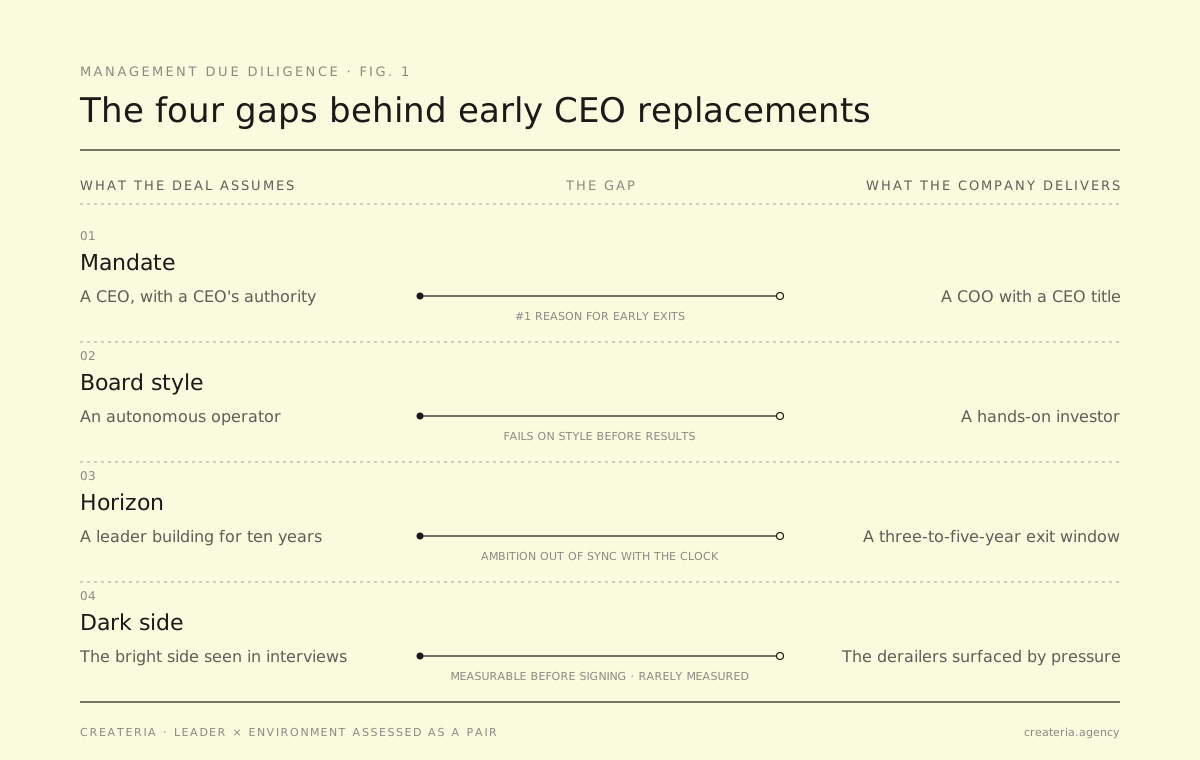
In our experience across PE-backed companies, the same four gaps sit behind most of the early replacements:
The mandate gap. The fund says it is hiring a CEO and means a COO with a CEO title. The executive arrives expecting authority that was never going to be delegated. This single mismatch between assumed and real authority is the most common reason we see for a portfolio CEO leaving early in the hold.
The board-style clash. In a PE-owned company, the relationship with the fund is not part of the job – it is the job. An autonomous operator under a hands-on investor, or a consensus-seeker under a fund that wants speed, will fail on style long before failing on results. The same holds in family investment funds, where the board is the family – and where formal authority and real influence can diverge without anyone saying so out loud.
The horizon mismatch. A PE hold is a three-to-five-year window to exit. An executive whose ambitions run longer builds an empire the fund will sell; one whose ambitions are already met is bored by month eighteen. Ambition has to be synchronised with the exit clock.
The dark side under pressure. Leaders get promoted on their bright side and derail on their dark side – and a leveraged, quarterly-reported, exit-driven environment applies exactly the pressure that surfaces it. The charismatic, risk-tolerant CEO who sold the board brilliantly in diligence is often the same profile that dismantles the management team in year two. This is measurable before signing; it rarely is measured.
What management due diligence should actually cover
Five questions, asked before signing – not in the first hundred days:
1. The thesis-role map – and the real mandate. What must be true, organisationally, for the thesis to work? Which roles carry that load? And what will each of them genuinely be allowed to decide? The last part has to be tested against the board, not read from the term sheet.
2. The decision system around the leader. Who does the CEO listen to, defer to, work around? How does the owner or fund behave when a plan stops working? Many "CEO failures" are system failures: the person was capable, and the decision architecture around them made capability irrelevant.
3. The team and its legacy. Who is actually in the leadership team, who left and why, and what the team over- and under-supplies. Homogeneous teams feel aligned in diligence meetings and fall apart under transformation pressure. A new leader inherits a system, not a role.
4. The executives themselves – with tools that predict. Structured, behaviour-based interviews built on real incidents rather than narratives. A work sample: have the CEO defend a 100-day value-creation plan against the fund's own thesis. Psychometrics that measure not only style and motives but derailment risk under stress. Reference triangulation with people the assessor chooses – former boards and investors included – not the names the candidate offers.
5. The drivers behind the CV. What actually motivates this person – mastery, influence, commerce, security, legacy? And does the environment supply it? A motive the company cannot satisfy is a resignation on a twelve-to-eighteen-month delay.
The cheapest moment to learn the truth
Every one of those questions can be answered before the deal closes, at a cost that rounds to zero against the deal size. Answered after closing, the same questions cost a year or two – the window in which nearly two-thirds of PE firms end up replacing a portfolio CEO.
Management due diligence done properly does not always change the deal. Sometimes it confirms the team and sharpens the first-hundred-days plan. Sometimes it changes what the fund promises the CEO about autonomy – or what it demands. And sometimes it surfaces, before signing, the replacement that would otherwise have surprised everyone in month nine. Then it is no longer a surprise, or a crisis, but a plan.
That is the difference between hoping the leadership holds and knowing what it will hold.
Createria assesses leaders and the environments they enter as a pair – for PE funds, family investment funds and their portfolio companies, before the search, before the deal, before the surprise. If you have a deal or a portfolio company in mind, start a conversation.