Executive Search for VC-Backed Startups in Portugal: A Founder's Guide

Ivan Tkach, Co-Founder & Managing Partner
Portugal has become very good at producing startups. Lisbon has hosted Web Summit for a decade and will keep it until at least 2028. Porto counts several hundred startups and scale-ups in its metro area. The tax regime for incoming talent was rebuilt around technology and innovation, the visa routes for engineers are among the fastest in Europe and a generation of companies founded here has reached global scale.
What the ecosystem has not yet produced in quantity is executives who have already run the stage you are about to enter. That single fact should shape every C-level search a VC-backed Portuguese startup runs, and most of them are run as if it were not true.
The shape of the pool
Portuguese venture funding is dominated by seed and Series A rounds. Growth-stage capital mostly arrives from abroad, and it arrives with expectations: a CFO who has closed a Series B, a COO who has taken a company from forty people to two hundred, a CRO who has built a sales organisation across three markets.
The number of people who have done those things inside a Portuguese company is small. The companies that scaled from here to global size can be counted on two hands, and their alumni are known by name to everyone who matters. Many are already committed, several have founded their own companies and the rest receive the same three calls each month.
So the honest starting point for a founder is this: a C-level search for a VC-backed startup in Portugal is a cross-border search by default. The local pool is real but shallow. The ocean is right behind it.
Four pools, four different searches
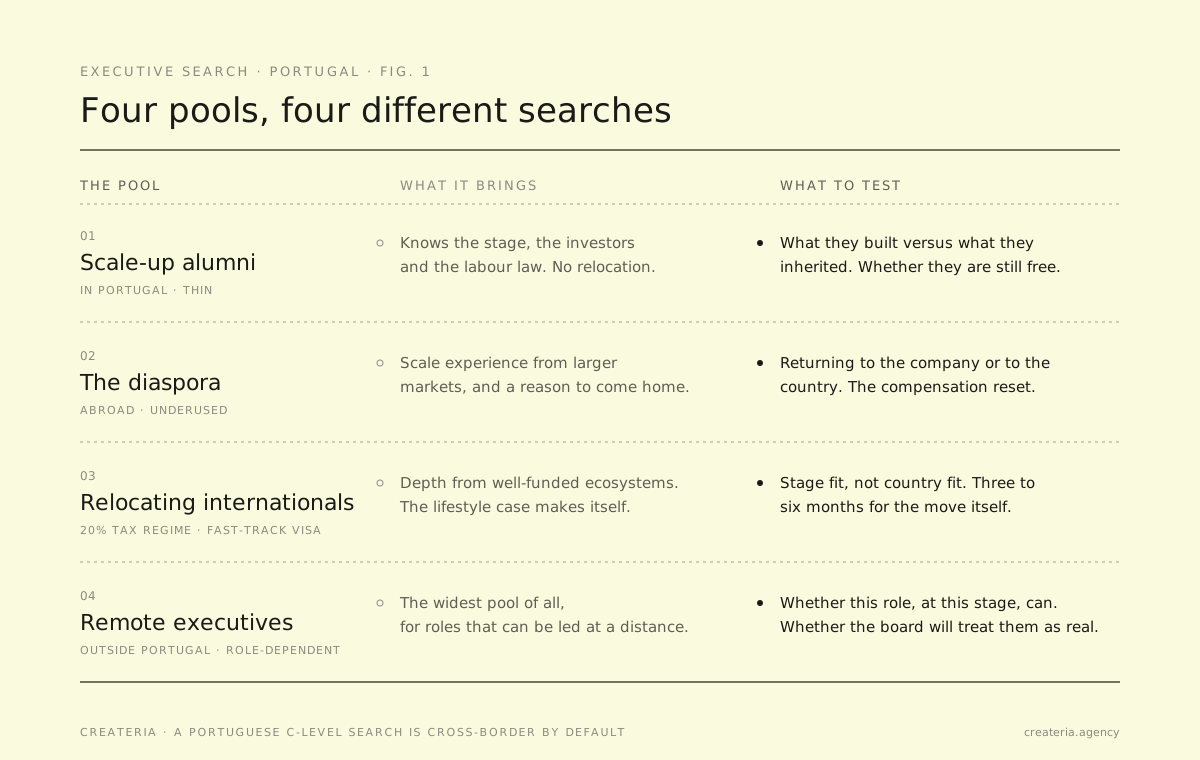
In practice, candidates for a Portuguese C-level role come from four places, and each has its own logic, its own risks and its own way of being tested.
1. Scale-up alumni in Portugal. They know the stage, the investors and the labour law, and they need no relocation. The pool is thin, and its members are often pre-committed. The question to test is not whether they were there when the company scaled, but what they personally built and what they inherited. A title from a company that grew is not evidence that its holder made it grow.
2. The diaspora. Portuguese executives who built careers in London, Berlin, Amsterdam or the United States, and who are now considering coming back. This is the most underused pool in the country. The risk is specific: some are returning to Portugal rather than to your company, and the job is the ticket. Test what they would do with your role if it were in a city they had no reason to move to. Test, too, how they respond to a compensation level that will be lower than what they left.
3. Internationals willing to relocate. The lifestyle case for Lisbon and Porto makes itself, and the incentives are concrete: the current tax regime for incoming qualified professionals offers a 20% flat rate on qualifying income for ten years, and accredited technology companies can bring talent in on a fast-track visa. What the incentives do not fix is stage fit. An executive from a well-funded German scale-up may be relocating into a company with a third of the resources and none of the structure, and the lifestyle will not compensate for that in month six. Test for the stage, not the country, and budget three to six months for the move itself.
4. Remote executives outside Portugal. For some roles, at some stages, the leader does not need to be in the office. For others the idea is a fiction that survives only until the first crisis. The question to settle before opening this pool is not whether great remote candidates exist. It is whether this role, at this stage of this company, can be led from a distance, and whether the board will treat a remote executive as a real member of the leadership team or as an advisor with a title.
Why the usual channels underperform here
Founders typically try two channels before calling a search firm, and both fail for reasons that are structural rather than accidental.
The first is the investor's network. The lead investor knows a great CFO. The introduction is warm, the candidate is credible and the founder feels unable to say no. We have written about why C-level hiring breaks when decision-makers step aside, and the investor-introduced candidate is the purest case: the person who has to live with the hire every day was not the one who chose it.
The second is the established search firms. Portugal has serious ones, and most are built for the corporate market: banks, retail, energy, telecoms. Their networks are corporate networks, and their process is calibrated to executives who will inherit a functioning organisation. A VC-backed company at Series A is hiring someone to build the organisation, and the profile that impresses a corporate board is frequently the profile that fails in a company of thirty people, where the CFO also runs procurement and the COO has no team yet.
What to settle before the search starts
Three things, in writing, before anyone is called.
The stage jump the hire has to make possible. Not the current stage. The one the next round is meant to fund. If the role exists to get the company from ten to fifty people, the candidate has to have made that jump, or shown the potential to make it, and the second is not the same as a bigger CV. Potential shows up as learning speed, as the ability to name what was wrong last time and as a track record of doing things for the first time without a playbook.
The mandate. What this executive will decide alone, what the founder keeps and what happens when they disagree. For a first C-level hire this is the moment the founder's own authority gets redefined, which is why the agreements to reach before a COO search apply, almost line by line, to a Portuguese founder hiring their first executive with a board watching.
The compensation reality. Portuguese executive salaries sit below London or Berlin, and the gap is not closing quickly. Equity closes part of it, but only with candidates who can read a cap table, so equity literacy is a screening criterion, not a nice-to-have. The tax regime for incoming talent closes another part, and it applies only to some candidates in some pools. Decide which pools the package can realistically reach before spending three months discovering it.
How to assess once the pool is open
The interview most founders run with an executive candidate is a conversation between two people who like each other. Its predictive validity is low. What predicts is structured: behaviour-based interviews built on real incidents, not narratives; a work sample in which the candidate takes a genuine problem from the company and presents a plan to the actual board; psychometrics that measure not only style but how the person behaves under the pressure of a company running out of runway; and references chosen by the assessor rather than the candidate, including the investors and boards they worked with before.
The founder's side of the pair has to be assessed with the same seriousness. How this founder actually makes decisions, what they cannot delegate yet, how the board behaves when a plan stops working. Half of the executive failures we see in early-stage companies are not failures of the executive. They are failures of a system that was never examined, and the executive was the first person to collide with it.
A realistic timeline
A C-level search for a VC-backed company in Portugal, run across all four pools, takes eight to twelve weeks to a signed offer, plus the notice period and, for a relocating candidate, the move. Founders who start the search when the need becomes urgent will spend a quarter without the leader they need, and the next round's investors will notice.
The alternative is to start when the signals appear: the founder doing a job they should have handed over, the board asking the same question twice, the term sheet that names the hire as a condition. At that moment the pool is still open, the mandate can still be designed rather than improvised and the search can be what it should be in a country like this one: wide, deliberate and honest about where the candidates actually are.
Createria is based in Portugal and runs C-level searches for founder-led and VC-backed companies across Europe, assessing the executive and the company they are joining as a pair. If your next round depends on a hire you have not yet made, start with a conversation.