Organisational Due Diligence: A Checklist for PE Deal Teams

Ivan Tkach, Co-Founder & Managing Partner
A deal team usually knows more about a target's working capital than about how the company actually runs. The numbers arrive with a data room and weeks of advisers' time. The organisation arrives with an org chart, a management presentation and an impression formed over two or three dinners.
We wrote about the leader's side of this in our piece on management due diligence: how to assess the CEO and the top team for the mandate, the board and the hold. This is the companion piece. It covers the other half of the pair – the organisation the leader walks into – and it is written as a checklist an operating partner can use before signing.
What the checklist is for
Organisational due diligence has two jobs. The first is to establish whether this organisation can carry the value creation plan in the three to five years the fund has. The second is to describe what a leader will inherit on the first day of the hold: the authority that is really on offer, the dependencies, the habits and the people who are quietly preparing to leave.
It does not score individuals, and it is not a culture survey. It is a structured reading of how the company holds together, built from evidence rather than from the presentation. The checklist covers six areas, each with questions to ask, evidence to request and red flags.
How to collect the evidence
Four sources, used together. Each corrects the blind spots of the others.
- Document review. Board minutes for the last two years, the delegation of authority, the monthly management pack exactly as it is sent, senior hiring and exit files from the last three years and any employee survey the company has run. Read them for what was done, not for what should have happened.
- Structured interviews two levels below the CEO. The presentation comes from the top team. The organisation is visible one and two layers down, where heads of function carry out what was agreed above them. Use the same questions with everyone, ask about recent incidents rather than opinions and record answers in the interviewee's own words. Each conversation needs 45 to 60 minutes.
- Site observation. A management meeting attended as an observer and an afternoon where customer problems arrive. Notice who speaks first, who is interrupted and who is sent for when something goes wrong.
- Reference triangulation. A former executive, a finance lead who has left, a key supplier, a lender. People the deal team chooses rather than the names management offers. When three sources describe the same pattern independently, treat it as a finding.
Access below the top team usually comes late, with management's agreement and a clear explanation of purpose. Negotiate it early, or the deal team is left with the presentation and nothing to test it against.
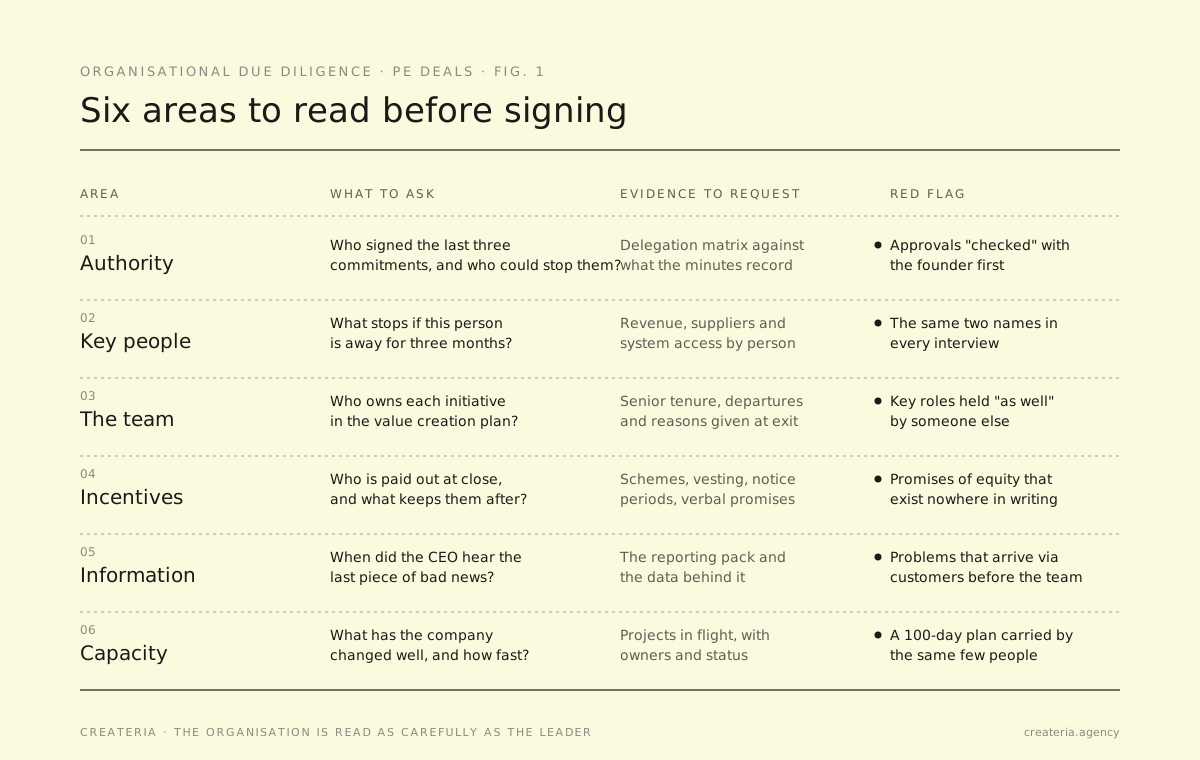
1. Authority: formal and real
The org chart shows who reports to whom. It rarely shows who can approve spending, hire, stop a project or change a price, and who has to check with someone first.
- Ask: walk me through the last three significant commitments the company made. Who proposed each one, who could have stopped it and who signed?
- Request: the delegation of authority, then compare it with the approvals actually recorded in minutes and correspondence for the same period.
- Ask: which matters still go to the founder or the previous owner, formally or otherwise?
- Red flag: approvals that formally sit with a function head but are routinely "checked" with the founder first.
- Red flag: a founder who steps back from the CEO role but keeps the chair, a board seat or an undefined title, with nothing written about what they will stop approving.
2. Key-person dependencies
In most companies of the size PE buys, two or three people hold more than their roles describe: client relationships, the knowledge of how the systems really work, the trust of the people below them. They are often not in the management presentation.
- Ask: if this person were away for three months, what would stop? Ask it about each member of the top team, then ask the second level.
- Request: revenue by account owner, critical supplier relationships and system access by person. Ask, too, what documentation exists for core processes.
- Ask: who do people go to when the official route is too slow?
- Red flag: the same one or two names appear in every interview as the person who "really knows", and neither sits in the senior team.
- Red flag: a key person whose title, pay and equity bear no relation to what they hold.
3. The management team: composition and gaps
The companion piece covers how to assess the individuals. This section looks at the team as a unit, against what the plan will ask of it.
- Ask: who owns each initiative in the value creation plan? Map every initiative to a named person and see where the names repeat.
- Request: senior tenure, senior departures in the last three years and the reasons recorded at exit.
- Ask: what does this team do well together, and what does it consistently avoid? A team built around one strength – selling, building product, controlling cost – often has nobody to balance it.
- Red flag: roles that exist on paper but are held "as well" by someone with another full-time job, most often in finance, people or operations.
- Red flag: a team hired by the founder within the same few years, in which nobody has worked under a different owner.
4. Incentives and retention after close
A transaction changes every senior person's arithmetic. Some will receive a significant payment at completion. Others will find that their informal standing does not survive a new owner.
- Ask: who receives a material payment at close, and what keeps them engaged afterwards?
- Request: current incentive schemes, vesting schedules, notice periods and a list of any promises the founder has made about equity, promotion or roles.
- Ask: which people below the top team would a competitor approach first, and what would it take to keep them?
- Red flag: promises of equity or seniority that appear nowhere in writing.
- Red flag: key people with nothing tying them to the hold, or with everything paid out on its first day.
5. Information flow and how bad news travels
Culture is hard to diligence as a list of values. It is easier as behaviour: what happens to information when it is unwelcome.
- Ask: tell me about the last time something went wrong with a customer or a project. When did the CEO hear about it, and from whom?
- Request: the monthly reporting pack and the data behind two or three of its figures. Ask how much of it is assembled by hand.
- Observe: whether anyone in the management meeting disagrees with the CEO, and what happens next.
- Red flag: figures in the pack that the second level cannot reconcile with what they see in their own areas.
- Red flag: problems that reach the CEO through customers or the board before they come through the team.
6. Capacity for the plan and the first hundred days
The value creation plan is a list of initiatives. The organisation has to absorb them while running the business and learning a new owner's reporting rhythm.
- Ask: what has this company changed successfully in the last three years – a system, a pricing model, a reorganisation – and how long did it take?
- Request: the current project portfolio with owners and status, to see how much change is already in flight.
- Ask: which initiatives in the plan need capabilities the company does not yet have, and which depend on the same few people?
- Red flag: a 100-day plan that assumes new reporting, a new system and two senior hires at once, all owned by people who already carry the business.
- Red flag: no example of a change the company completed without the founder driving it personally.
What to do with the findings
The checklist produces facts and patterns, not a verdict. What matters is where they go next.
Into the investment case. Some findings affect price or structure. A key-person dependency may justify a retention package or a deferred element. A missing finance capability may need to be costed into the plan rather than assumed.
Into the 100-day plan. Each red flag becomes either an action with an owner or a risk the board watches by name. Gaps in authority become the first conversation with the CEO about what the board will delegate and what it will keep. Retention risks become individual conversations in the first fortnight, not the first quarter.
Into the hiring brief. If a role has to be filled or a leader replaced, the findings describe the environment the new person will enter: who holds real influence, what the team lacks, where information slows. A brief written from that reading looks for someone who can work in this organisation, not one with a strong record elsewhere.
This is the reading we do in The Mirror: a structured look at how a company actually holds together – where authority sits, what rests on one person, where what is said and what is done diverge – before anyone is asked to change it.
Reading the organisation as carefully as the leader
Much of what makes a portfolio leader struggle during the hold is visible in the organisation before the deal closes: authority that was never delegated, a dependency nobody named, a team that cannot absorb the plan, news that travels upwards too slowly. None of it appears in the financial model. Most of it can be found by asking the right people, while the fund still has room to act on the answers.
A clean organisational reading does not guarantee the deal. It means the hold starts with the organisation the fund actually bought, rather than the one in the presentation.
Createria reads the organisation and the leader as a pair – for PE and VC funds, their portfolio companies and founder-led businesses. If a deal or a portfolio company is on your agenda, start with a conversation about what the organisation will hold, and what it will not.